Legacy System Migration — Complete Guide
How to modernize an aging system safely — the strategies, sequencing, and safeguards that prevent a migration from becoming a disaster.
Why legacy migration is risky — and worth it
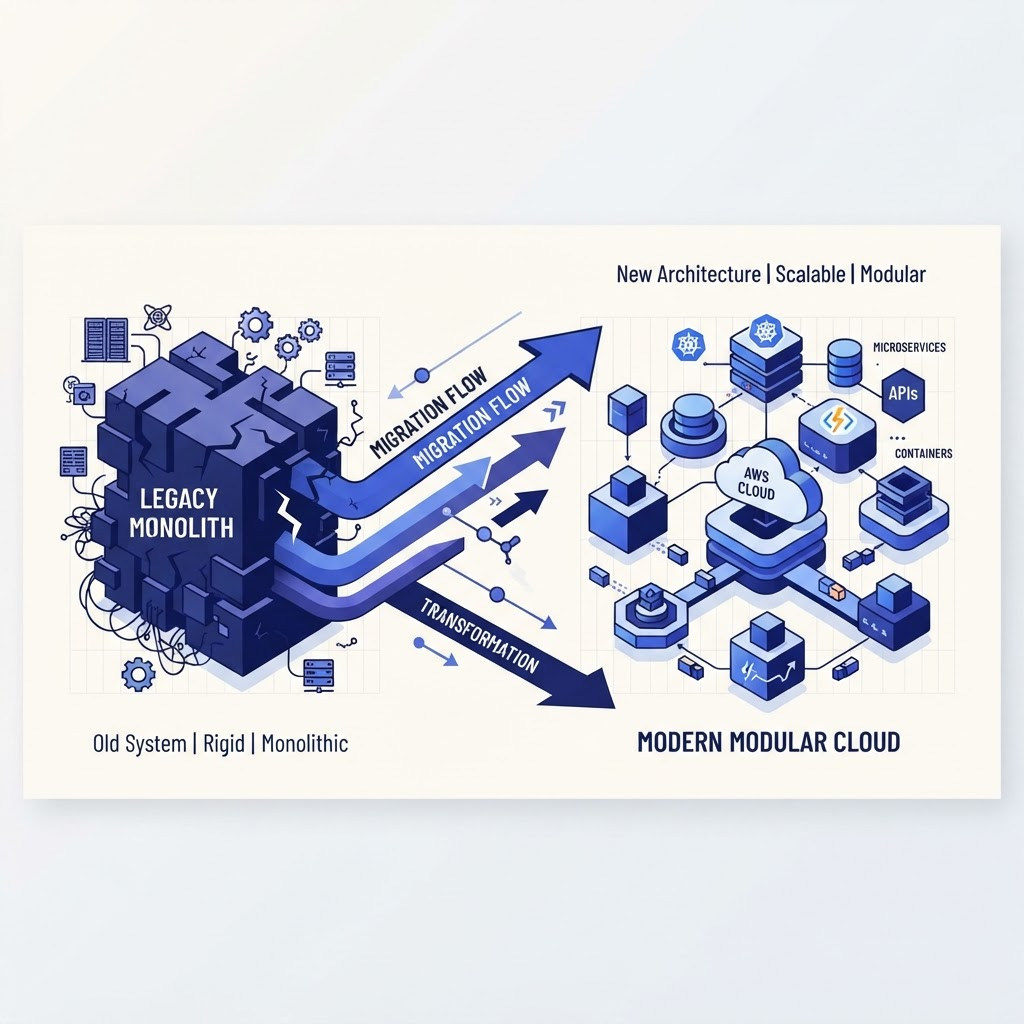
Legacy systems power a surprising amount of the world’s critical infrastructure, and for good reason: they work. But over time they become brittle, expensive to maintain, and impossible to change quickly. Every new feature takes longer, talent is harder to find, and one bad deployment can take down the business.
Migration is worth the risk when maintenance costs balloon, security exposure grows, or the system blocks the business from moving forward. The goal is not modernization for its own sake — it is restoring the ability to change safely and ship value again.
Choosing a migration strategy
There is no single right way to migrate. The best approach depends on your risk tolerance, timeline, and how tangled the existing system is.
- Strangler fig: incrementally replace pieces of the old system while it keeps running — the safest approach for critical systems.
- Rewrite: rebuild from scratch when the old system is beyond saving; higher risk, but a clean slate.
- Re-platform: move to modern infrastructure with minimal code change to capture quick wins.
- Hybrid: combine strategies, modernizing the highest-value modules first.
A safe migration playbook
Regardless of strategy, safe migrations follow a disciplined sequence. Start by mapping the existing system and its data thoroughly — undocumented behavior is where migrations go to die. Build a comprehensive test suite that captures current behavior so you can prove the new system matches it.
Migrate incrementally, running old and new systems in parallel behind feature flags, and keep a tested rollback path at every step. Migrate and reconcile data carefully, validating integrity before cutover. Finally, plan for a support window after launch — the first weeks reveal the edge cases no plan anticipated.
Frequently asked questions
Anywhere from a few months to over a year, depending on system size, complexity, and the chosen strategy.